
Competitive Edge Technology’s Seven Step Plan
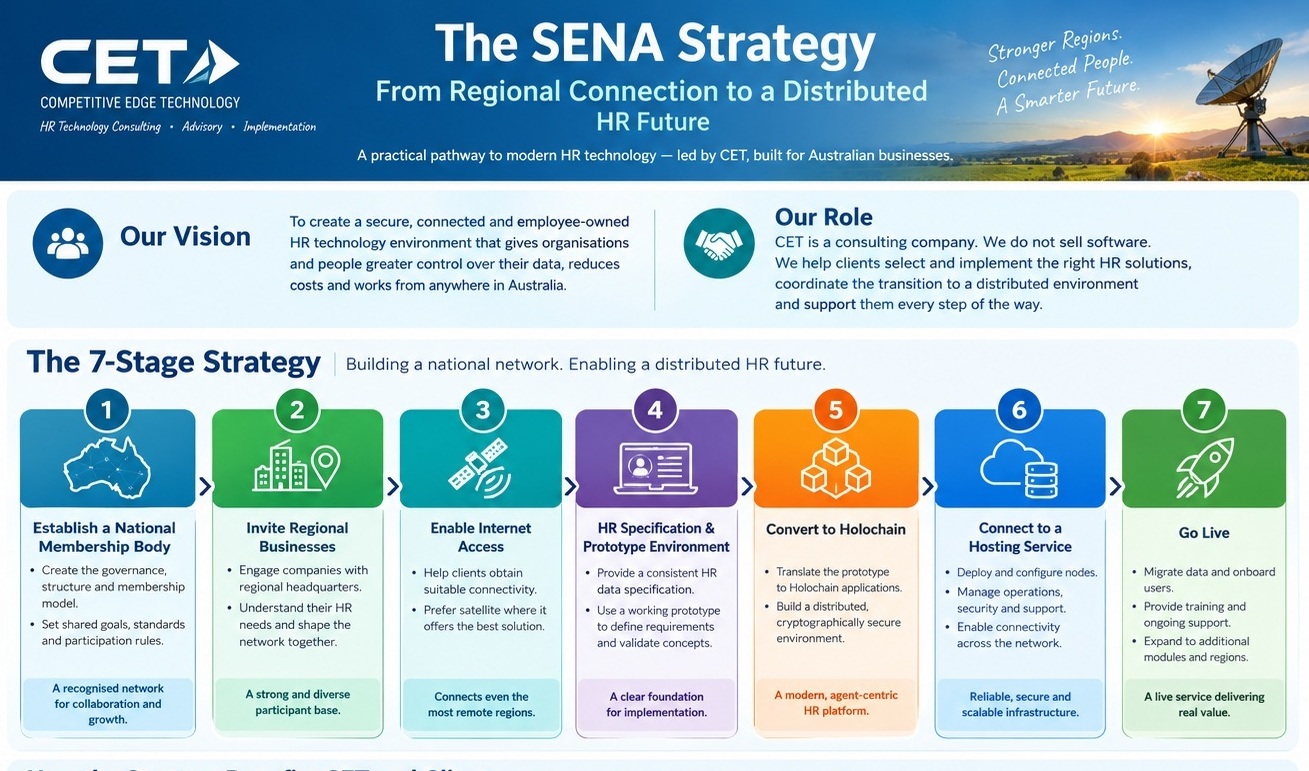
Employee-Owned Data and the Next Generation of HR Technology
Modern technology has caught up with cloud computing. The era for cloud dominated enterprise applications and SaaS delivery is nearing the end and the platform must change. We believe the next generation of HR technology requires a new fit-for-purpose hybrid development and delivery platform.
After many years of waiting for the technology to mature, we believe the time has come to start building it – on the Holochain platform
HR has reached the point where the technology beneath it needs to change
For more than three decades, HR technology has progressively moved from payroll and personnel systems to integrated Human Resource Information Systems, cloud platforms, SaaS and increasingly AI-enabled applications.
Yet one fundamental assumption has remained largely unchanged:
The organisation owns the HR technology platform, and the employee’s information resides within it.
The next generation of HR technology has an opportunity to change that relationship.
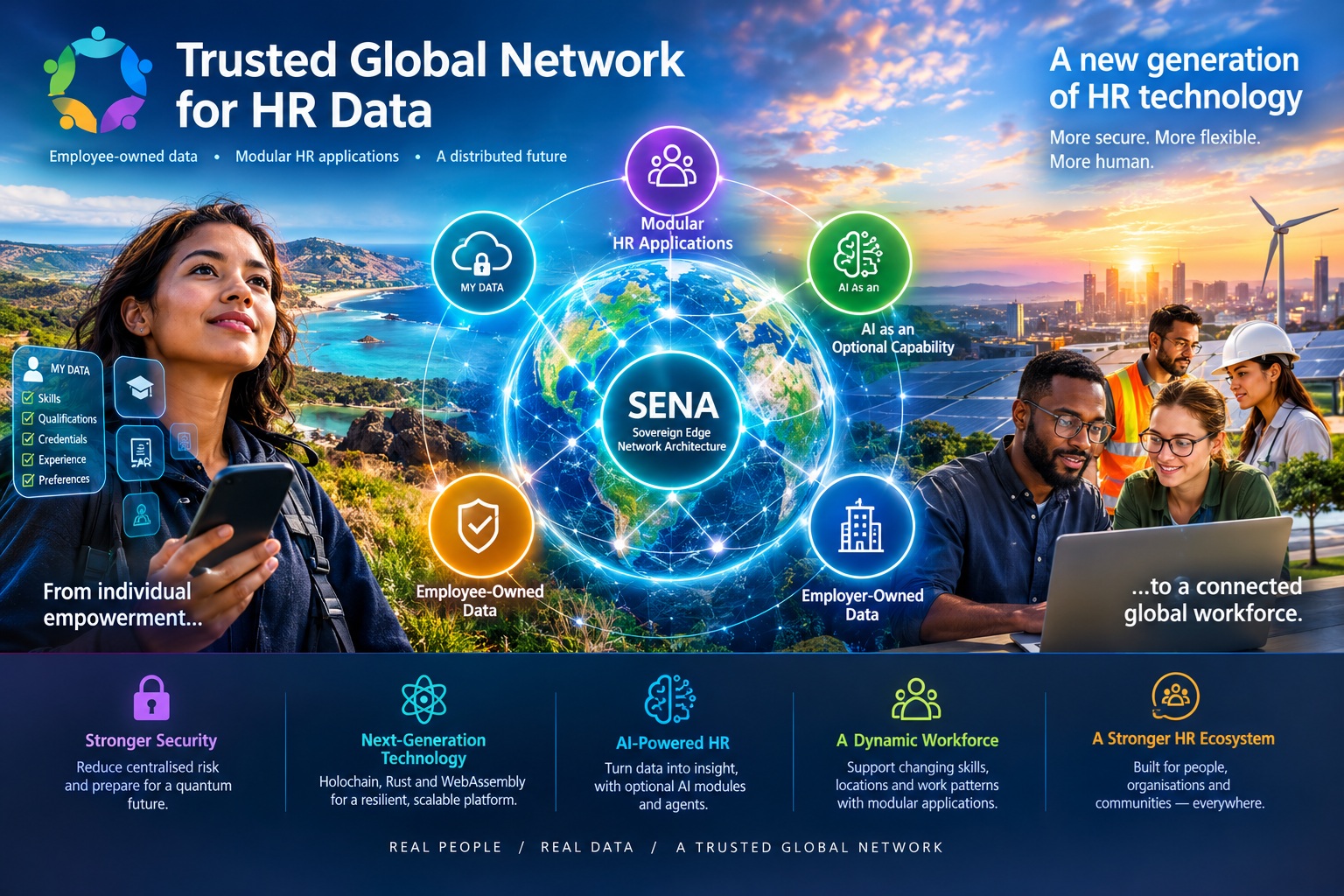
The Trusted Global Network for HR Data is exploring how employee-owned data, employer-owned data and modular HR applications can operate within a distributed environment using Holochain – providing a potential new foundation for HR technology in the age of AI, edge computing and increasingly sophisticated cyber threats.
Holochain describes itself as an agent-centric, peer-to-peer application framework in which users can control their identity and data, with applications operating across participants’ devices rather than relying on a single central database. Its current architecture also provides cryptographic data integrity and peer validation.
We believe HR should be one of the next major application domains for this technology.
A long wait – but now the timing is different
The concept behind the Trusted Global Network for HR Data has been developing for many years. We have deliberately waited rather than attempt to force HR onto a distributed technology before the underlying platform was sufficiently mature.
That patience has been important.
Holochain’s development has now reached a significantly more mature stage, with version 0.7.0 released in July 2026 and continued work on stability, networking, performance, developer tooling and application development. Holochain’s own roadmap identifies local-first operation, HDK stability, mobile builds, network infrastructure and DNA migration among its development priorities.
The question is therefore changing.
It is no longer simply:
“Can distributed technology be used for HR?”
It is becoming:
“Why continue building the next generation of HR technology on an architecture designed for the previous generation?”
Why the time for change has arrived
The environment in which HR systems operate has changed dramatically.
Cybersecurity has become a permanent strategic issue. Centralised databases provide enormous concentrations of valuable information and therefore attractive targets. Holochain enables a different approach: participants maintain their own data and applications communicate through encrypted peer-to-peer networks, reducing reliance on a single central database or infrastructure point.
Quantum computing is changing the security horizon. The threat does not require a cryptographically relevant quantum computer to exist today. NIST is already urging organisations to begin migrating to post-quantum cryptography, noting that encrypted information can be harvested now and potentially decrypted later.
Artificial intelligence has changed the value of data. HR data is no longer simply information to be stored and retrieved. It is becoming an input to prediction, workforce modelling, generative workflows, simulation and increasingly autonomous AI systems. This makes data ownership, provenance, authorisation and controlled access substantially more important.
The workplace itself has become dynamic. Employees increasingly move between organisations, occupations, locations and forms of work. Skills and capabilities change rapidly. Organisations need to assemble and replace applications as their requirements change rather than repeatedly replace an entire HR technology platform.
The traditional assumption of a large, centralised HR database surrounded by tightly coupled applications is increasingly being challenged by these changes.
Employee-owned data changes the model
The Trusted Global Network for HR Data proposes a different starting point:
The employee should be able to own and control their personal HR data.
That does not mean that employers lose control of information they legitimately own.
Instead, Competitive Edge Technology’s SENA project is based on the proposition that employee-owned data and employer-owned data can coexist while authorised HR applications provide the interoperability between them.
For example, an employee could retain control of their credentials, skills, qualifications or other personal information while an organisation retains its job requirements, organisational structures and operational information.
An authorised HR application could then bring the two together for a particular purpose – such as credential verification, skills matching, workforce planning or capability assessment – without requiring all of the underlying information to be transferred into one central corporate database.
Holochain’s data model supports both private data held on an agent’s device and public data shared through the distributed application network.
This creates the possibility of moving from:
“Where is the employee’s data stored?”
to:
“Who owns the data, who is authorised to use it, and for what purpose?”
From HR platforms to modular HR applications
This is where SENA – the Sovereign Edge Network Architecture – takes the concept further.
Rather than creating another monolithic HR system, SENA is intended to provide an environment in which modular HR applications can be added, replaced and upgraded as organisational requirements change.
The underlying principle is:
Employee-owned data. Employer-owned data. Interoperable HR applications.
A new HR capability should not require an organisation to replace its entire HR platform.
A business could introduce a workforce-planning application, a credential-verification application, an AI workflow, a capability-matching application or another specialist HR function while retaining its existing data and other applications.
This is particularly important as AI begins to change the way HR applications are created.
AI can become a modular capability – not another source of lock-in
The Trusted Global Network for HR Data is also exploring how AI can be incorporated into this architecture.
Existing HR knowledge, business rules and AI functions can potentially be transformed into modular application capabilities. AI can assist in constructing, testing, adapting and operating those applications, while the resulting production applications remain governed and version-controlled.
The objective is not to make SENA dependent upon one AI provider.
Instead:
Organisations describe the capability they need → AI can help construct the modular application → automated development processes test and package it → the distributed infrastructure executes it.
This opens the possibility of an HR technology environment in which AI becomes a replaceable intelligence layer, rather than another proprietary platform around which the organisation becomes locked.
Holochain Development Environment
There is another important development occurring beneath this architectural change.
Holochain’s application development environment uses Rust for its DNA/zome development, with Rust code compiled to WebAssembly. Holochain’s current developer documentation explicitly assumes Rust familiarity for DNA development.
At the same time, Rust is receiving increasing recognition beyond the distributed technology community.
Microsoft has publicly described Rust as a memory-safe systems programming language and has been progressively adopting Rust to replace or complement memory-unsafe C/C++ components. Microsoft has also stated that it is investing in memory-safe languages such as Rust for new products and existing systems.
This is significant for the future of distributed applications.
It does not mean that Microsoft is endorsing Holochain. Rather, it provides powerful independent validation of the direction toward memory-safe, high-performance systems software — precisely the environment in which Holochain’s Rust-based architecture operates.
For SENA, this creates an interesting convergence:
Holochain → distributed application architecture
Rust → memory-safe systems software
WebAssembly → portable application execution
AI → dynamic application construction and intelligence
Employee-owned data → a new HR data model
Together, these technologies provide the foundations for a fundamentally different approach to HR technology.
The next generation of HR technology
The Trusted Global Network for HR Data has therefore not been designed simply to create another HR application.
Its objective is more fundamental:
to explore whether the architecture of HR technology itself can be changed.
After a long period of watching distributed technology mature, we believe the opportunity has arrived to begin demonstrating what an HR-specific Holochain ecosystem could look like.
Holochain has already demonstrated the underlying concepts of agent-centric applications, local data ownership, peer-to-peer networking and distributed validation. What is still missing from the Holochain ecosystem is a major HR application domain that demonstrates how these capabilities can be applied to the world’s enormous and increasingly valuable body of workforce information.
That is the opportunity for SENA.
About SENA Microgrid Project Participation
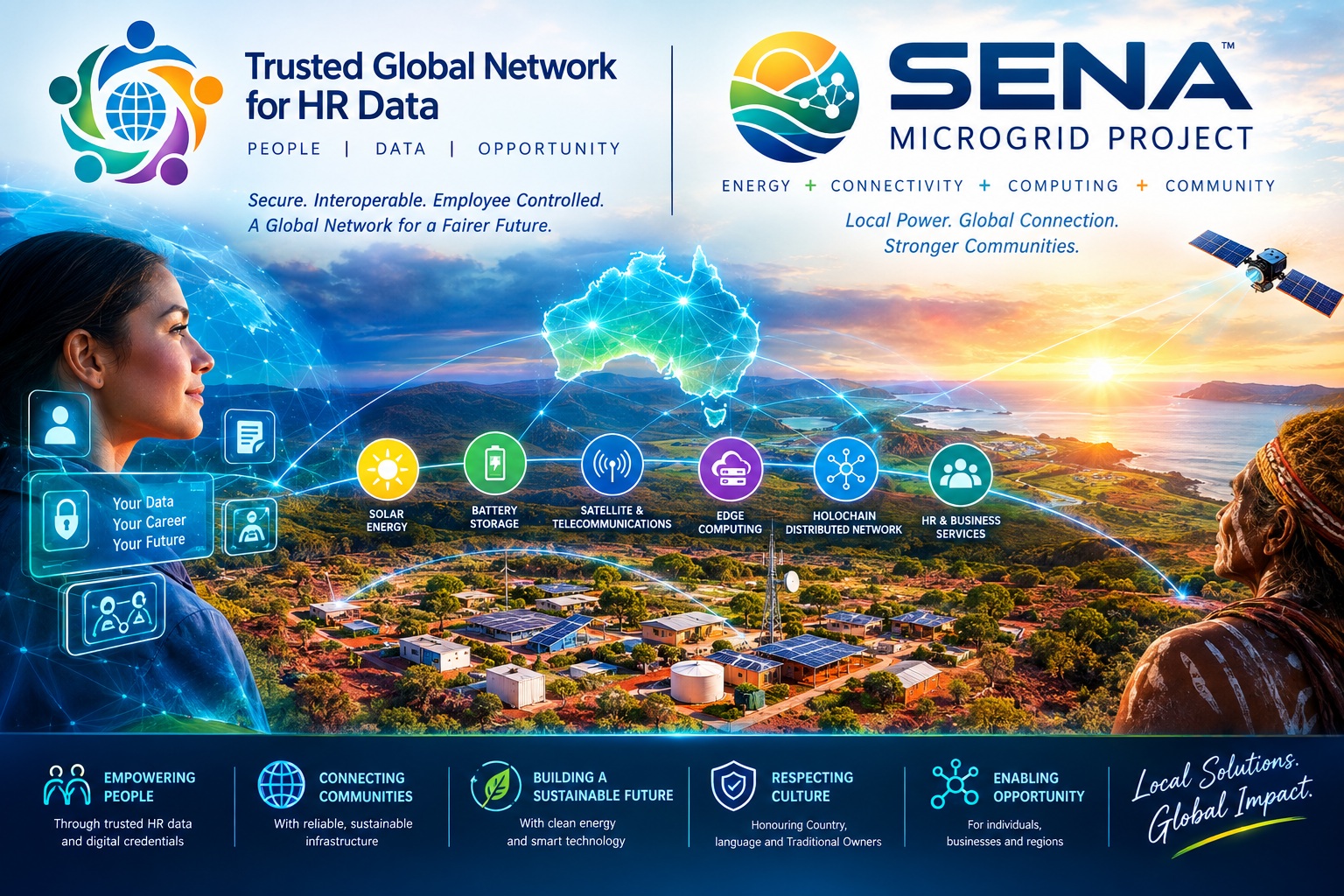
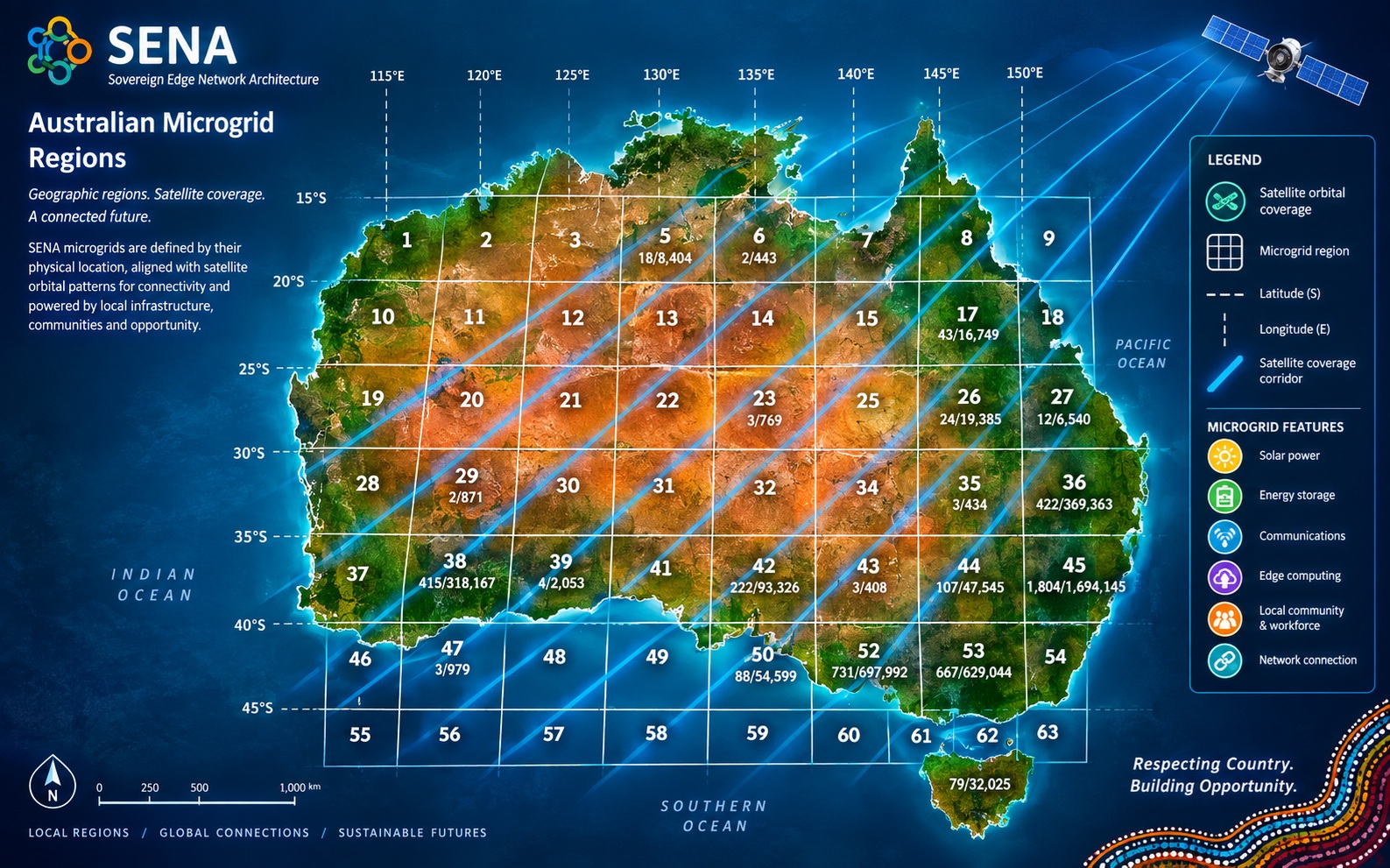
The SENA (Sovereign Edge Network Architecture) Microgrid Project is a new approach to building the infrastructure for the connected regional economy – and to redefining how people control their digital identity and employment data in the AI era. It brings together local renewable energy and storage, satellite and telecommunications connectivity, Edge computing, Holochain distributed technology, AI, and secure HR and business applications within geographically defined regional networks influenced by satellite orbit paths, shown in the diagram below:
A fundamental principle of SENA is Employee Data Ownership and Portability: rather than treating an individual’s employment data as something permanently locked inside an employer’s HR system, data can be licensed to the individual, enabling it to become portable, secure and available to the person throughout their working life. Using distributed ledger technology, SENA provides the potential for individuals to maintain control over their own employment identity, credentials, experience and capability data, while giving organisations trusted mechanisms to exchange and verify the information they need. Rather than relying entirely on centralised cloud infrastructure, each SENA Microgrid creates distributed local capability closer to the people, organisations and communities it serves – providing a foundation for data sovereignty, AI readiness, local employment, digital capability and economic opportunity. The vision is simple: your data, your identity, your career – portable by design, protected by technology and connected to opportunity globally.
Follow this link for a short series on explanatory videos
A Decade of Development
Ten Years in the Making — Built for What Comes Next
SENA is the culmination of more than ten years of research, investment and development by Competitive Edge Technology (CET) into distributed technology, employee-owned data, AI-ready HR infrastructure and the future of the connected regional economy.
Competitive Edge Technology — Established 1994
Independent thinking. Long-term investment. Infrastructure for the next generation.