Microgrid Naming Convention | Decision Rights & Accountability | The Global Governance Concept |
SENA – Governance

Governing a Trusted Global Network for HR Data
A peer-to-peer network cannot be governed in the same way as a conventional cloud-based HR system.
In a traditional HR technology environment, an organisation generally contracts with a software vendor, the vendor operates the platform and database, and the vendor’s terms, security controls and technical architecture largely determine how the system operates.
The Trusted Global Network for HR Data takes a different approach.
Built around the principles of Holochain and the proposed Sovereign Edge Network Architecture (SENA), the network distributes application execution, data and responsibility across participating organisations, people and infrastructure providers. Holochain applications operate through shared rules that participating peers validate, rather than relying on a central application server to enforce every transaction.
This makes governance a fundamental component of the technology architecture.
It determines who can participate, what constitutes valid data, how information may be exchanged, how components interact, how disputes are handled and how the network evolves.
From Centralised Control to Shared Governance
The objective is not to replace one central authority with another.
Instead, SENA can provide a framework in which the organisations and people who use the network have a meaningful role in establishing the rules under which it operates.
The governance model can establish rules covering:
- membership and participation;
- identity and credentials;
- data ownership and stewardship;
- data access and consent;
- validation and verification;
- security and privacy;
- component certification;
- interoperability;
- network upgrades;
- dispute resolution;
- hosting and service standards;
- commercial arrangements; and
- admission and removal of participants.
These rules can then be reflected, where appropriate, in the technical architecture of the Holochain applications.
Holochain’s DNA provides the executable rules for a particular peer-to-peer network, while zomes provide the application functionality and data logic. Changes to the DNA’s integrity configuration can create a new network identity, making governance of application rules an important part of network evolution.
Governance therefore sits between the people, the business rules and the technology.
The Hosting Agent
A key role in the SENA model is the Hosting Agent.
A Hosting Agent is not simply a conventional cloud hosting company.
In a distributed environment, organisations and other participants may operate infrastructure that helps maintain the availability and connectivity of the network. Holochain’s architecture is designed so that participants run application code on their own devices, while additional infrastructure can provide important services such as peer discovery and relay connectivity.
A SENA Hosting Agent could therefore provide a combination of:
Network infrastructure
Operating the equipment, connectivity and supporting services required by participating organisations and regional networks.
Holochain services
Installing, configuring, monitoring and maintaining Holochain conductors and the SENA applications operating within them.
Network availability
Providing appropriately configured always-on nodes or other infrastructure where continuous availability is required. Holochain’s own operating guidance recognises the role of always-on nodes in improving availability for real-world networks.
Security
Maintaining appropriate physical, network and operational security around the infrastructure under the Hosting Agent’s control.
Membership administration
Supporting the approved process for admitting organisations, services and other authorised participants to a particular SENA network.
Governance administration
Maintaining the operational records, policies, procedures and reporting required by the network’s governance arrangements.
The Hosting Agent does not, however, become the owner of the network’s data merely because it provides infrastructure.
That distinction is fundamental.
Governance Is More Than Hosting
A Hosting Agent can operate infrastructure without becoming the central authority over the information flowing through it.
This is one of the important differences between a SENA network and conventional cloud HR software.
The Hosting Agent’s role can be defined by the governance framework, with clear boundaries around:
what the Hosting Agent may do
and
what the Hosting Agent must not do.
For example, the governance framework could establish that the Hosting Agent may:
- provision network infrastructure;
- monitor network health;
- provide technical support;
- facilitate connectivity;
- maintain agreed operational services; and
- administer authorised network functions.
But it should not automatically acquire unrestricted rights to:
- inspect employee information;
- repurpose personal information;
- sell or commercialise employee data;
- alter validated records;
- override an individual’s permissions; or
- determine the business rules governing HR data on behalf of the network.
This separation between infrastructure responsibility and data authority is central to establishing trust.
People Data at the Centre
HR data is different from many other categories of enterprise information.
It can describe a person’s identity, employment, skills, qualifications, remuneration, experience, performance, credentials and relationships with organisations.
As AI increasingly operates on workforce information, the significance of these data relationships becomes even greater.
The SENA proposition is therefore not simply to distribute an HR database.
It is to create a framework in which people, organisations and applications can establish trusted relationships around workforce information.
An employee could, for example, have an identity and collection of authorised information that can interact with multiple SENA capabilities without requiring every application to maintain a complete copy of the person’s HR history.
A credential could be verified without transferring an entire personnel record.
A qualification could be presented to a prospective employer without exposing unrelated information.
A workforce application could obtain the information it is authorised to use without automatically gaining access to everything else associated with the individual.
This approach is consistent with Holochain’s agent-centric architecture, in which participants maintain their own identities and data and share information with peers according to application rules and permissions.
HR Organisations Should Help Write the Rules
The governance of workforce data should not be left exclusively to technology companies.
HR professionals, employers, employees, professional associations, industry bodies, technology providers, privacy specialists and other stakeholders have different perspectives on what constitutes appropriate use of workforce information.
The Trusted Global Network provides an opportunity to bring those perspectives into the governance process.
HR-related organisations could participate in developing rules for:
- what constitutes a trusted HR data element;
- how employment information should be represented;
- who may author or verify particular information;
- how credentials should be issued;
- how information should be shared between employers;
- how employee consent and permissions should operate;
- how AI systems may use workforce information;
- how information should be retained;
- how information should be corrected;
- how data provenance should be established; and
- what responsibilities apply to organisations and service providers.
This is particularly important because technical interoperability does not automatically create trustworthy HR data.
The network needs both.
Technical interoperability
and
professional governance.
An Australian Model for Global Expansion
Australia provides an opportunity to develop and test a practical model before extending the architecture internationally.
The proposed approach is to establish an Australian SENA network as a reference implementation.
Regional networks or “microgrids” could bring together participating employers, HR organisations, technology providers, Hosting Agents and other approved participants.
Each regional network could operate according to the common SENA framework while retaining appropriate local governance and operational responsibility.
The model could then be progressively extended:
Australia
→ establish the governance framework
→ develop the SENA technical standards
→ establish Hosting Agent responsibilities
→ test HR data and component interoperability
→ demonstrate regional Edge infrastructure
→ establish trusted network operating procedures
→ document the model
→ make the framework available internationally.
The objective would not be to create an Australian-controlled global network.
Rather, Australia could provide the first practical governance and technical model from which other countries and regions could establish their own SENA networks.
The same principles could then be adapted to different legal, regulatory, cultural and employment environments.
A Global Federation of Networks
The long-term vision is therefore not necessarily one enormous global HR database.
It is a network of networks.
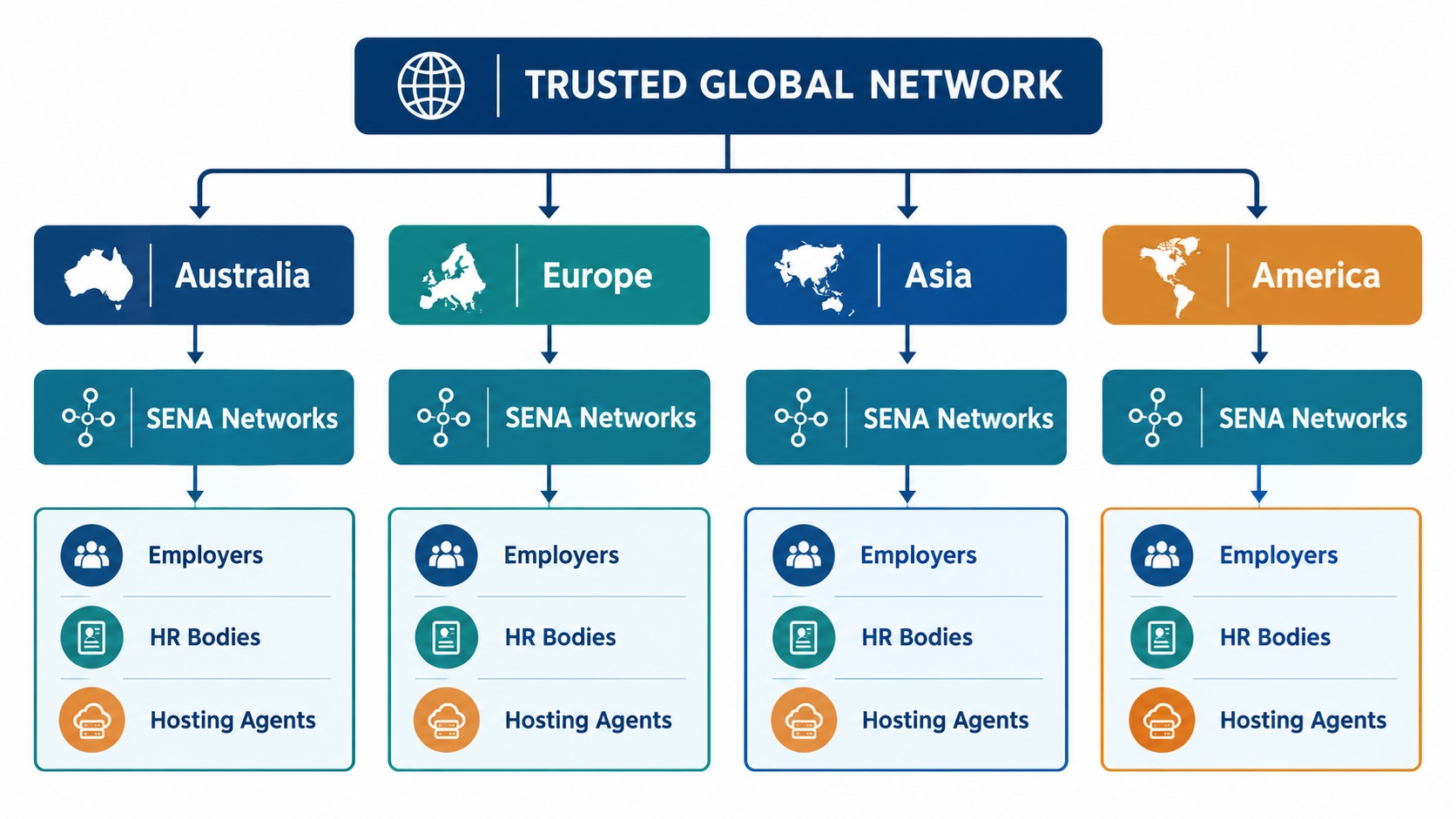
Each network can maintain its own governance arrangements while participating in a broader framework of interoperability and trust.
This creates the possibility of local sovereignty with global interoperability.
Governance of an Open Ecosystem
SENA is intended to be an open framework.
That means the governance model should not prescribe a single HR application.
Instead, it can establish the rules and interfaces through which different components participate.
A recruitment component from one provider could potentially be replaced by a recruitment component from another provider, provided both satisfy the applicable SENA capability and trust requirements.
The same principle can apply to:
- payroll;
- recruitment;
- learning;
- workforce planning;
- performance;
- credentials;
- skills;
- remuneration;
- AI services; and
- future HR capabilities that do not yet exist.
The network therefore becomes an ecosystem of interchangeable capabilities, rather than another monolithic HR software product.
Governance as a Living System
Governance cannot be written once and then forgotten.
As technology, employment practices, AI capabilities, privacy expectations and regulatory environments change, the rules governing the network will also need to evolve.
A mature SENA governance structure could therefore include representatives from:
Employees
Employers
HR professional organisations
Technology providers
Hosting Agents
Privacy and security specialists
Industry bodies
Academic and research organisations
and other participants with a legitimate interest in trusted workforce data.
The purpose is not to create bureaucracy.
It is to ensure that the rules governing a network built around people’s data are developed by the community that depends upon that network.
The Governance Principle
The fundamental principle is simple:
Technology should enforce trusted rules, but the community that uses the network should have a voice in creating those rules.
Holochain provides an architectural foundation in which application rules, data integrity, identity and peer-to-peer participation can be built into the application itself.
SENA builds on that foundation by proposing a governance framework specifically suited to distributed HR applications, employee-related data and an open ecosystem of interchangeable components.
The Australian implementation can become a practical proving ground.
The Hosting Agent can provide the infrastructure and operational capability.
HR organisations can help define the professional rules.
Employers can help define business requirements.
Employees can have a greater role in determining how information about them is accessed and exchanged.
Technology providers can build interoperable components.
And the global network can grow not through central ownership of everyone’s data, but through shared rules, trusted relationships and interoperable participation.
From a central HR system to a trusted HR network.
From software ownership to participation.
From a single application to an ecosystem.
From data silos to trusted, governed exchange.